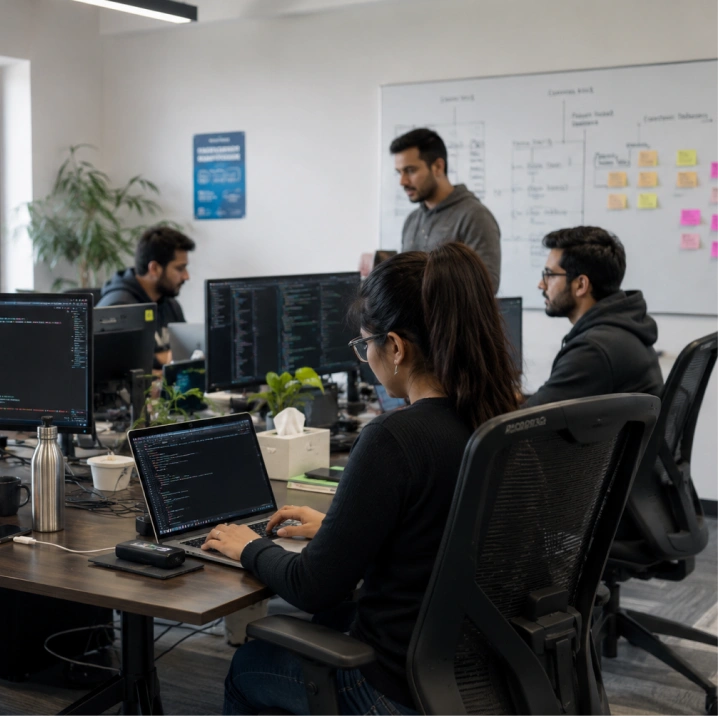
AllianceTek's DevOps engineers work inside the same delivery teams as our developers, not as an outside team bolted on once something's already broken. Pipelines, infrastructure, and deployment process go through the same review and QA discipline as everything else we ship.
Work in Your Time Zone
15 days free trial

DevOps at AllianceTek isn't a separate department that gets looped in after a release goes sideways, our DevOps engineers sit inside the same delivery teams building the application they're deploying. Hire DevOps engineers through us and you get people who work inside our standard process, architecture review, QA, project management, instead of a contractor parachuting in to fix one pipeline and leaving. One engineer can own your CI/CD setup or a cloud migration. A full DevOps team can take on infrastructure, deployment, and monitoring together. Either way, whoever's writing your Terraform has usually already broken something similar on a different project and knows what the fix looked like.
Our DevOps engineers bring AI into the parts of the job that are mostly repetition. Drafting a first pass at a Terraform module, for one, or scanning through logs after an alert fires to find the line that actually explains what happened. It's also decent at putting together a runbook so the third person on call this quarter isn't starting from nothing. None of that replaces the judgment call on what to actually change in production, or when a rollback beats pushing a patch under pressure. An engineer signs off before anything touches a live environment, and that step doesn't get skipped just because AI wrote the first draft.
Our dedicated DevOps engineers provide practical solutions for reliable delivery, scalable infrastructure, and secure cloud operations as per your business requirements.
Not every DevOps engagement starts with a blank slate, some start with a pipeline that half-works and a team that's tired of babysitting deployments. Our engineers audit what's already there first and build a roadmap around fixing the parts actually causing pain.
A deployment that used to take an afternoon and a checklist should take one command and a few minutes of waiting. Hire DevOps engineers from AllianceTek to build that pipeline around your actual stack, not a generic template pulled from a blog post.
Moving off on-prem servers, or from one cloud provider to another, touches more than just where the servers live, DNS, data transfer, and a cutover window that can't take the application down for a business day. Our DevOps engineers plan for that instead of finding out about it mid-migration.
Terraform, Pulumi, or CloudFormation, whichever your team already uses or wants to standardize on. Our engineers write infrastructure definitions that get reviewed the same way application code does, so a change to your environment isn't a manual click-through nobody can audit later.
Running containers in production is a different problem than running them on a laptop during a demo. Our DevOps engineers set up Kubernetes clusters built for actual failure scenarios, a node going down, a bad deploy, traffic that spikes without warning.
Systems fail, that's not really preventable, but finding out from a customer instead of a dashboard is. Our engineers wire up monitoring and alerting so someone on your team knows about a problem before it shows up as a support ticket.
Security scanning that only runs before a big release catches maybe half of what it should. Our DevOps engineers build vulnerability scanning and compliance checks into the pipeline itself, so an issue surfaces during a normal week instead of during crunch time before launch.
Cloud bills climb quietly, an unused instance here, an oversized database there, nobody notices until finance asks why the AWS invoice doubled. Our engineers audit resource usage and set up governance so spending stays visible instead of becoming a quarterly surprise.
A backup nobody's tested is really just an assumption that it'll work when needed. Our DevOps engineers set up recovery procedures and actually run them, so a bad deploy or a lost database is a bad afternoon instead of a multi-day scramble.
Pipelines and infrastructure need upkeep after launch too, dependency updates, a Kubernetes version approaching end of life, a monitoring rule nobody's touched since the person who wrote it left. Our engineers stay on to handle it instead of it becoming next year's fire drill.
As a discovery, we schedule initial call and understand your requirements, and scope of work.
Based on your objective and requirements, we simplify your hiring custom software developers for you & schedule interview with our experts.
Hire your ideal custom software developer that meets with your targets to begin process promptly.
Get on discovery call and hire our software developers or programmers with a dedicated model that suits well with your business and project requirements.
A dedicated resource working exclusively on your projects for 160 hours per month, ensuring consistent progress and deep project involvement.
A flexible resource working 80 hours per month, providing focused support for specific tasks or projects as needed.
Expert consulting services billed in non-expiring 40-hour blocks, offering the flexibility to engage on-demand for specific needs or short-term projects.
Manages the entire development process, ensuring quality and timely delivery, allowing you to focus on critical tasks.
Offers full project control with expert developers, ideal for companies with strong in-house teams needing additional talent.

Merges your in-house team with AllianceTek’s expertise, perfect for complex projects needing diverse skills and collaborative effort.
01
Most of the DevOps engagements we take on aren't starting from zero. Usually there's a pipeline that mostly works, held together by whoever set it up two jobs ago, and a team that's sick of manually restarting a deploy at 6pm on a Friday. We look at what's actually there before proposing anything, and the roadmap gets built around the two or three things actually causing pain, not a full teardown.
02
Most outages trace back to a change that skipped review or a monitoring gap nobody caught in time. Hire DevOps engineers from AllianceTek and both of those get caught earlier, because the same review process applied to application code applies to infrastructure changes too.
03
Building an in-house DevOps team means hiring for skills that don't always need to be full-time, someone who's excellent at Kubernetes might rarely touch cost optimization. AllianceTek's DevOps engineers bring that full range without you having to staff for each specialty separately.
04
We'll use Terraform if that's what your team's already standardized on, Pulumi or CloudFormation if that's the direction you're headed instead. Either way, the infrastructure gets defined in code and reviewed the same way a pull request for the application would be. Nobody's making a change by clicking through the AWS console and hoping someone remembers to write it down.
05
A lot of what slows down a launch isn't the application code, it's the infrastructure and deployment process built around it at the last minute. Our DevOps engineers set that up in parallel with development instead of after, and that alone tends to save real weeks.
06
An early-stage product and one handling real production traffic need different infrastructure decisions, and the wrong one made too early gets expensive to unwind. AllianceTek's DevOps engineers have built for both stages, so your setup matches where the project actually is.
07
Our DevOps engineers use AI to draft infrastructure code and sort through logs faster, then spend the time saved on the calls that actually carry risk, what to change in production and when. Nothing gets deployed until an engineer has reviewed it.
08
Cloud spend has a way of creeping up without anyone deciding it should, an instance someone spun up for a test six months ago is still running, a database sized for traffic you never actually got. Usually nobody catches it until finance flags the AWS bill. Our engineers go through what's actually being used and set up alerts so the next spike gets caught in week one instead of at the end of the quarter.
At AllianceTek, we have deep knowledge of various technologies that are necessary for developing DevOps developer to ensure the best solutions for your business. Here's a look at the tools and technologies our experts use to craft high-quality DevOps development.
Popular for mobile backends, storage, machine learning, and serverless applications.
Integrate Power Platform with Azure services for reliable and scalable cloud deployment.
NoSQL document database for scalable applications.
Infrastructure as Code tool for provisioning cloud environments.
It was popularised in the 1960s with the release of Letraset sheets.
Automation tool for configuration management, application deployment, and orchestration.
A framework for building Java-based microservices and web applications.
For containerization and orchestration, enabling consistent deployments and scalability.
Flexible NoSQL database for document-based and scalable application data.
Continuous integration tool for automating builds and testing.
Automation tool for CI/CD workflows in GitHub repositories.
Automates code integration, testing, & deployment processes.
CI/CD platform for automating builds and deployments.
Monitoring system and time-series database for metrics.
Open-source tool for querying, visualizing, and alerting on metrics and logs.
Cloud-based monitoring and analytics platform for IT infrastructure.
Elasticsearch, Logstash, Kibana for powerful log analytics.
Known for its simplicity and vast libraries, ideal for rapid development and AI/ML integration.
Automate system tasks and workflows through powerful command-line scripting.
Open-source, statically-typed programming language for building efficient applications.
Define structured configurations and automate workflows with a simple, human-readable format.
Secure secret management and encryption for infrastructure.
Security tool for finding and fixing vulnerabilities in dependencies.
Securely manage user access, permissions, and authentication across AWS resources.
Our engineers work across AWS, Azure, and Google Cloud rather than defaulting to whichever one they happened to learn first. That matters most when your infrastructure already spans more than one provider, or when you're trying to decide if it should.
Manual configuration changes are how environments drift apart until nobody can explain why staging and production behave differently. Our engineers write infrastructure as code by default, so an environment can be rebuilt from the repository instead of from memory.
Treating a pipeline like a side project instead of production code is how a Friday deployment turns into a weekend page. Our engineers hold infrastructure code to the same review standard as anything else that ships.
A pipeline that runs tests but takes forty minutes to give feedback slows a team down almost as much as no pipeline at all. Our engineers build for speed and reliability together, not just one or the other.
Setting up a dashboard is the easy part, deciding what actually deserves an alert at 3 AM versus what can wait until morning takes more judgment. Our engineers tune alerting so on-call doesn't mean getting paged for noise.
You get a status update on the same day every week without having to ask for one, plus a heads-up if something worth flagging comes up sooner. Infrastructure work especially benefits from this, since a lot of it is invisible until something breaks.
Look for hands-on experience with at least one major cloud provider, plus whatever CI/CD tool your team's already using or open to adopting. Ask about incident response specifically, that's usually where you can tell a good DevOps hire from a mediocre one, more than how clean their pipeline diagrams look. Kubernetes matters a lot if you're already running containers, and a lot less if you're nowhere near that yet.
Infrastructure changes go through code review the same way application changes do, nothing gets applied to production straight from someone's laptop. We test failure scenarios deliberately instead of waiting to find out how a system behaves under real load.
You work directly with the engineers building your pipelines and infrastructure, not through an account manager relaying updates secondhand. There's a standing weekly review, and if something's on fire before then, you hear about it immediately, not at the next scheduled call.
They take on infrastructure and pipeline work the same way a developer takes on a feature, sized, estimated, and built as part of the sprint. They're in standups and retros with everyone else, and they report to your product owner or engineering lead directly.
Yes, hourly, part-time, full-time, or a monthly retainer, depending on whether you need ongoing infrastructure management or a defined project like a cloud migration. If the scope changes later, the arrangement can change with it instead of locking you into the original plan.
From small businesses to large enterprises, our testimonials highlight the transformative experiences and the tangible value we deliver.
Our Finest Achievements
With a track record of successful projects and satisfied clients, we strive for excellence in every endeavour, ensuring that our best work becomes a catalyst for our client's success.
View All portfolio